
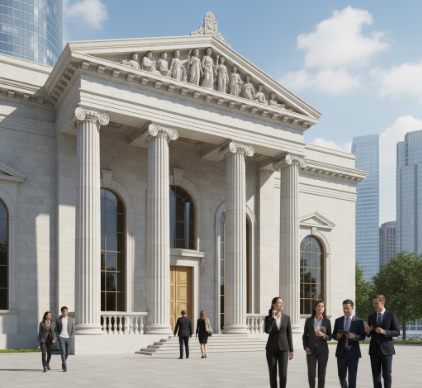
I used to think neoclassicism was just rich people copying Greek statues.
Turns out, the whole thing started as a kind of visual rebellion—wait, maybe rebellion isn’t the right word, more like a course correction. By the mid-1700s, European art had gotten so ornate, so dripping with Rococo curlicues and pastel cherubs, that a bunch of artists and architects basically looked at ancient Rome and said: we need to get back to that. The thing is, they weren’t just photocopying classical forms. They were filtering Greco-Roman principles—symmetry, proportion, restraint—through Enlightenment ideas about reason and civic virtue. Johann Joachim Winckelmann, this German art historian who’d never actually been to Greece, wrote these wildly influential essays arguing that Greek art represented “noble simplicity and quiet grandeur.” And people ate it up. Suddenly, every public building needed columns, every portrait needed that stoic, marble-eyed stare, every sculpture needed to look like it had just stepped out of Pompeii, which—ironically—had only been rediscovered in 1748, give or take a few years.
Here’s the thing: neoclassicism wasn’t one movement. It was more like a series of visual arguments happening across different countries, different decades, different media.
When Architects Decided Less Was Definitately More
Jacques-Louis David’s paintings are probably the most famous examples—those huge, theatrical history scenes with their sharp lines and frozen gestures. “The Oath of the Horatii” (1784) basically became a instruction manual for how to compose a neoclassical painting: shallow space, sculptural figures, muted colors, everything arranged like a stage set. But architecture is where the style really dug in. In England, Robert Adam was designing country houses with delicate plasterwork borrowed from Roman interiors. In France, Claude-Nicolas Ledoux was dreaming up these austere, geometric buildings that looked like they’d been carved from pure concept. Thomas Jefferson—yeah, that Jefferson—was so obsessed with classical architecture that he modeled the Virginia State Capitol after a Roman temple he’d seen in Nîmes, and later designed Monticello with a dome lifted straight from the Pantheon. I’ve seen photos of Monticello, and honestly, it’s kind of eerie how much it feels like a Roman villa transplanted to a Virginia hillside. The proportions are classical, but the context is completely new.
The Marble Gaze and the Problem of Emotion
One of the weird contradictions of neoclassicism is how it tried to be both timeless and politically urgent. Antonio Canova’s sculptures—like “Psyche Revived by Cupid’s Kiss” (1787-1793)—are so polished and perfect they almost don’t look real. But they were also expensive commissions for Napoleon and other powerful figures, which means the “noble simplicity” was never as democratic as Winckelmann claimed. And the emotional range was narrow. Classical subjects meant classical restraint: no messy feelings, no bodies in decay, no everyday chaos. Jean-Auguste-Dominique Ingres painted these impossibly smooth nudes that seem to exist outside time, but they also feel a little cold, a little distant, like looking at someone through glass.
I guess it makes sense that the style eventually wore itself out.
Why the Revival Mattered Beyond Just Aesthetics
By the 1820s, Romanticism was already pushing back, demanding more emotion, more wildness, more individualism. But neoclassicism left its fingerprints everywhere—on government buildings, on currency, on the way we still associate columns and pediments with authority and permanence. The U.S. Capitol, the British Museum, the Arc de Triomphe: all neoclassical, all designed to make you feel small and civic-minded at the same time. And that’s the real legacy, I think—not the statues or the paintings, but the idea that visual form could embody political values, that a building could argue for reason and order just by how it looked. It’s a weird kind of power, when you think about it. A column doesn’t do anything except hold up a roof, but it also carries roughly 2,500 years of cultural baggage about democracy and empire and what it means to build something that lasts. Maybe that’s why neoclassicism never fully went away—it just keeps getting revived, recontextualized, argued over. Anyway, I still think those Greek statues are kind of cold, but I get why people in the 18th century looked at them and saw a blueprint for the future.


