
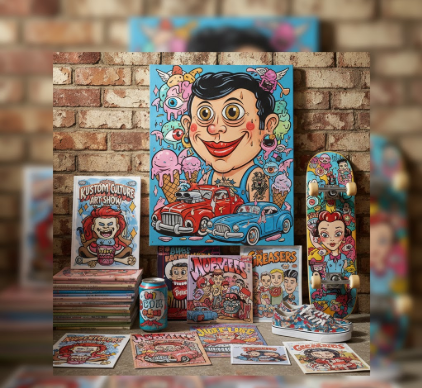
I used to think lowbrow art was just, you know, kitschy hot rod paintings and tattoo flash.
Then I spent three months interviewing designers who’d built entire careers on what started as a rebellion against the stuffiness of fine art galleries in the 1970s. The lowbrow movement—born in Southern California’s underground scene, championed by artists like Robert Williams and the Juxtapoz crowd—wasn’t trying to be respectable. It was trying to be seen. And here’s the thing: it worked so well that now you can’t walk through a Target without seeing its DNA splattered across throw pillows and phone cases. The movement took imagery from hot rods, surf culture, comic books, and B-movies, then smashed them together with a kind of gleeful disregard for what art critics thought was proper. Museums hated it. The public ate it up. By the early 2000s, lowbrow had infiltrated album covers, skateboard graphics, and—this is where it gets messy—corporate branding.
I guess it makes sense that rebellion eventually gets commodified. But the speed surprised me. One designer I spoke with, who’d worked on packaging for a major energy drink brand, told me they’d literally been handed a stack of old Juxtapoz magazines and told to “make it look like that.” No irony, no wink.
When Cartoonish Grotesquery Became a Corporate Aesthetic
The visual language of lowbrow—exaggerated anatomy, garish color palettes, irreverent mashups of high and low culture—started showing up in places that would’ve appalled its founders. Street wear brands like Ed Hardy (designed by Christian Audigier, riffing heavily on tattoo artist Don Ed Hardy’s work) turned lowbrow imagery into mall fashion by the mid-2000s. Suddenly, skulls with roses and pin-up girls with devil horns weren’t countercultural—they were on sale at Macy’s. This wasn’t appropriation in the usual sense; many of the original artists were involved, licensing their work, sometimes enthusiastically. But something got lost in translation. The grit, the defiance, the sense that this art existed specifically because galleries wouldn’t touch it—all that evaporated when it became a product strategy.
Designers I interviewed were conflicted about this. One told me she loved the accessibility—”finally, weird art for regular people”—but also felt exhausted by how quickly it became a parody of itself. Another pointed out that lowbrow’s influence on digital design, particularly in app icons and game interfaces, has been surprisingly durable. The exaggerated expressions, the chunky outlines, the way characters seem to burst off the screen—that’s pure lowbrow DNA, even if most users have no idea where it came from.
Wait—maybe that’s the point.
The movement’s impact wasn’t about maintaining some pure aesthetic vision. It was about proving that art made for hot rod enthusiasts and tattoo collectors could compete with—and eventually infiltrate—mainstream visual culture. By the 2010s, lowbrow had splintered into pop surrealism, street art, and a dozen other micro-genres, but its core principle remained: if the establishment won’t validate you, build your own audience. Graphic designers absorbed this lesson, sometimes consciously, often not. The rise of independent design studios, the explosion of artist-driven merchandise, the whole Etsy-fication of visual culture—you can trace a line back to lowbrow’s DIY ethos. It taught a generation of creatives that you didn’t need a gallery show to matter. You just needed people who got it.
The Uncomfortable Truth About Lowbrow’s Legacy in Contemporary Design Practices
Here’s where I get uncomfortable: lowbrow’s success also paved the way for some truly cynical design work. Because once you’ve established that “irreverent” and “edgy” sell, you can manufacture those qualities without any of the underlying authenticity. I’ve seen design briefs that explicitly call for “lowbrow-inspired” aesthetics—meaning cartoonish violence, sexualized imagery, deliberate ugliness—without any connection to the subcultures that birthed those visuals. It becomes a style to deploy, not a perspective to inhabit. And honestly, some of the original lowbrow artists have been complicit in this. Licensing deals, collaborations with brands that have nothing to do with car culture or tattooing—it’s hard to blame them for cashing in, but it definately muddies the movement’s legacy.
Yet the influence persists in ways that feel generative rather than extractive. Independent poster designers, zine makers, small animation studios—they’ve taken lowbrow’s permission structure (anything can be art, any audience is valid) and run with it in directions the original movement never imagined. I spoke with a UI designer who cited Robert Williams as an influence on her work for a mental health app, arguing that lowbrow’s embrace of the grotesque helped her create interfaces that didn’t sanitize difficult emotions. That felt like a through-line worth preserving: the idea that visual design doesn’t have to be polite or palatable to be effective.
The lowbrow movement didn’t set out to change graphic design, branding, or digital interfaces. It set out to exist on its own terms. Turns out, that was enough to recieve the attention of an entire industry looking for ways to signal authenticity, edge, and cultural fluency. Whether that’s a triumph or a cautionary tale depends on who you ask. Probably both.


