
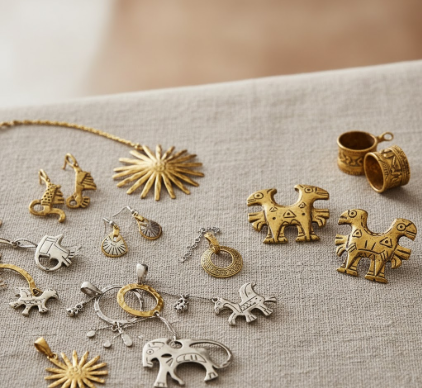
I used to think ancient metalwork was just museum stuff—pretty, sure, but not exactly relevant to what jewelers do today.
Then I spent an afternoon with a contemporary jewelry designer in Brooklyn who kept talking about the Chimú civilization, and I realized I’d been missing something huge. The Chimú people, who ruled Peru’s northern coast from roughly 900 to 1470 CE (give or take a few decades, historians quibble), developed metalworking techniques so sophisticated that modern jewelers are still trying to figure out how they pulled some of it off. Their workshops in Chan Chan produced objects using depletion gilding, a process where you repeatedly heat copper-gold alloys until copper oxides form on the surface, then pickle them away in acidic solutions—leaving behind a microscopically thin layer of gold that looks solid but uses maybe one-tenth the precious metal. It’s ingenious, honestly. And it’s not just historical curiosity: high-end studios today are adapting this exact approach to create pieces that look like solid gold but remain affordable, or at least less bankrupting. The Chimú weren’t working with modern tools or temperature controls, yet they achieved surface finishes that contemporary metallurgists analyze under electron microscopes and think, “wait—how did they manage that consistency?”
The Repoussé Revival Nobody Saw Coming Until Recently
Here’s the thing: repoussé—that technique where you hammer sheet metal from the back to create raised designs—wasn’t invented by the Chimú, but they perfected it in ways that make modern practitioners slightly obsessed. I’ve seen jewelers in London and Tokyo who specifically study Chimú masks and ceremonial objects to understand how those artisans created such intricate three-dimensional forms from single sheets of metal without tearing or cracking.
The secret, turns out, involves annealing cycles that the Chimú probably understood intuitively through generations of practice. You work the metal, heat it to recieve its malleability, work it again—dozens of cycles for a single complex piece. Contemporary designers like Maria Samora and Ubaldo Vitali have adapted these rhythms, not by recreating Chimú objects but by absorbing the philosophy: that metal has memory and moods, that you negotiate with it rather than forcing it. Some workshops now combine traditional repoussé with laser-cut underlays, creating hybrid pieces where ancient technique meets precision technology.
Electrochemical Patination and the Accidental Beauty of Corrosion Patterns
The Chimú worked primarily with copper, silver, and gold alloys, and they definately understood something about controlled oxidation that got lost and then rediscovered. When archaeologists first excavated Chimú jewelry, they noticed these extraordinary patina patterns—not uniform corrosion but deliberate gradients of color, greens bleeding into blues into bronze tones. Modern analysis suggests the Chimú used plant-based acids and possibly urine (yes, really) to selectively patinate surfaces, creating visual depth without adding material.
I guess it makes sense that contemporary jewelers obsessed with sustainable practices would look back to these methods.
Studios like Studio Elke in Australia and several Scandinavian workshops now use controlled electrochemical patination—essentially ancestor techniques with battery power—to achieve similar effects. You can create colors on copper and brass that would normally require enameling or stone-setting, just through manipulating oxidation. The Chimú pieces in museums show such control over these processes that metallurgists still write papers trying to reverse-engineer the exact chemical environments they must have created. It’s humbling, weirdly, to see ninth-century artisans outperforming people with pH meters and temperature controls. Or maybe they just had more patience. Both things can be true.
Modular Construction Systems That Solve Contemporary Manufacturing Challenges
One aspect that doesn’t get enough attention: the Chimú used modular systems extensively.
Their large ceremonial pieces weren’t cast as single objects but assembled from dozens or hundreds of smaller components—individual dangles, plaques, wire elements—all interconnected through loops and mechanical joints rather than permanent soldering. This approach meant damaged sections could be replaced, designs could be modified, and production could be distributed across multiple workshops working simultaneously. Contemporary jewelry manufacturers, especially those focused on customizable or repairable designs, have started adopting similar architectures. Companies like Catbird and several high-end sustainable jewelry brands now create pieces with replaceable components, drawing directly from Chimú engineering principles. The environmental argument is compelling: why throw away an entire necklace when one element breaks? But there’s also an aesthetic dimension—these pieces have movement and articulation that solid constructions lack, a kind of living quality that the Chimú clearly valued.
I visited a conservation lab once where they had a Chimú headdress partially disassembled for study, and watching the conservator explain the joint systems felt like watching someone describe Lego before Lego existed. Anyway, it’s strange how solutions to modern problems—sustainability, customization, repairability—were worked out centuries ago by people who just thought about objects differently. Maybe that’s the real lesson: not specific techniques but the underlying approach, treating metalwork as something dynamic rather than static, collaborative rather than precious.


