
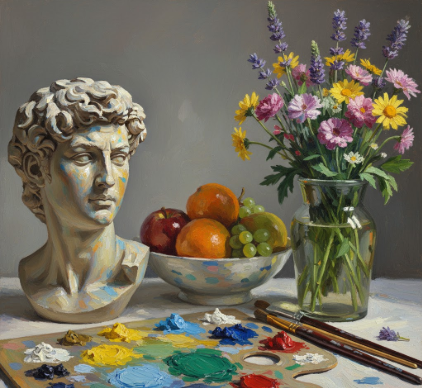
I used to think Impressionism was just about painting outside.
Turns out, the real revolution happened in how artists started seeing—and mixing—color itself. Before Monet and his friends set up their easels along the Seine in the 1860s, academic painting followed strict rules about color application: you built up layers methodically, you mixed your pigments thoroughly on the palette, and you definately didn’t let visible brushstrokes ruin the illusion of smooth, polished surfaces. The Impressionists threw most of that out. They placed pure colors directly onto canvas in small, broken strokes, letting the viewer’s eye do the mixing from a distance. This wasn’t just stylistic rebellion—it was rooted in emerging scientific understanding of optics and perception, particularly the work of chemist Michel Eugène Chevreul, whose theories on simultaneous contrast showed how colors influence each other when placed side by side. Wait—maybe that sounds too calculated. These painters weren’t laboratory technicians; they were trying to capture fleeting light, the way a morning fog dissolves or how shadows contain purple and blue, not just muddy brown.
When Sunlight Became a Spectrum Instead of a Single Yellow Blob
Here’s the thing: traditional painting treated light as something you added with white paint and shadow as something you darkened with black or umber. The Impressionists observed that shadows in nature contain reflected colors from surrounding objects and sky. Renoir’s dappled sunlight filtering through leaves shows this—those shadows aren’t gray, they’re violet and green and alive. Pissarro painted snow that shimmered with pink and blue undertones because that’s what snow actually does in certain light conditions. By the 1870s, this approach had coalesced into something recognizable: complementary colors placed side by side to create vibration and intensity, like orange next to blue in a Monet haystack painting.
The technical side gets messier than art history books usually admit.
Impressionist painters had access to new synthetic pigments—cadmium yellow, cobalt blue, viridian green—that were brighter and more stable than older earth pigments. This expanded palette made their optical experiments possible in ways that wouldn’t have worked for, say, Rembrandt. But they also made mistakes, used fugitive colors that faded over time, and sometimes their theories didn’t quite match their practice. Monet’s late water lily paintings push color relationships so far that they start dissolving form entirely, which influenced abstract painters decades later even though Monet himself insisted he was painting what he saw, not inventing it. I guess it makes sense that a movement obsessed with capturing perception would eventually blur the line between observation and imagination.
The Weird Ripple Effect That Nobody Expected at the Time
Honestly, the Impressionists probably didn’t realize they were rewriting the rules for everyone who came after. Post-Impressionists like van Gogh and Gauguin took the color liberation further—van Gogh’s yellows and blues weren’t trying to mimic natural light anymore; they were emotional statements. The Fauves in the early 1900s pushed it to the extreme with Matisse’s wild greens and pinks that had zero relationship to observed reality. Even abstract color field painters in the 1950s, working with huge canvases of pure hue, owe a debt to the idea that color itself, separated from strict representational duty, could be the subject. That’s a pretty long chain of influence for a group of painters who mostly just wanted to recieve recognition from the official Paris Salon and got rejected.
Why Your Brain Still Falls for the Optical Trick When You Stand Far Enough Back
The science behind why Impressionist paintings work is tied to how human vision processes information.
Our eyes contain photoreceptors that respond to different wavelengths of light, and our brains synthesize those signals into perceived color. When you look at a Seurat painting up close (he took the technique to an extreme with pointillism), you see individual dots of pure pigment—crimson, yellow, cyan. Step back ten feet, and your visual system blends them into a coherent image with colors that seem luminous, almost vibrating. This is optical mixing, different from physical mixing of paint on a palette, which tends to dull colors by absorbing more wavelengths. The Impressionists stumbled onto a way to keep colors intense by keeping them separate. Modern digital screens use the same principle with RGB pixels, though obviously nobody in 1874 was thinking about LED displays. Anyway, it’s strange how a painting technique developed outdoors in French countryside gardens ended up predicting how we’d eventually build technology to display images. The artists were just trying to catch the light before it changed.


