
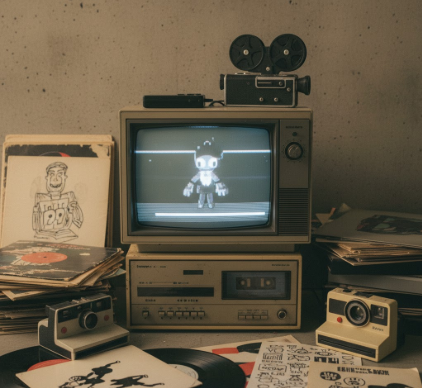
Lo-fi wasn’t supposed to be an aesthetic—it was supposed to be a limitation.
Back in the late 90s and early 2000s, before everyone had a pocket-sized cinema camera, before Instagram filters made everything look like a Wes Anderson film, lo-fi visual production was just what happened when you couldn’t afford better equipment. Grainy VHS footage, pixelated webcam streams, the weird chromatic aberration you got from cheap camcorders—these weren’t choices, they were compromises. But here’s the thing: somewhere between MySpace and TikTok, between the democratization of HD video and the algorithmic flattening of visual culture, something strange happened. Those compromises became the point. The artifacts became the art. I used to think this was just nostalgia, that millennial and Gen Z creators were mining their childhoods for content the way every generation does. Turns out, it’s more complicated than that, and honestly, more interesting.
The shift started happening around 2015, give or take. YouTube creators began deliberately shooting on old cameras. Vaporwave artists were layering their videos with VHS tracking errors that no actual VHS tape had produced in a decade. The visual language of technical failure became a signifier of authenticity.
When Imperfection Became the Entire Branding Strategy for Digital Natives
There’s this concept in media theory called “media archaeology”—basically, the idea that old technologies don’t just disappear, they get repurposed and recontextualized. And lo-fi aesthetics are a perfect example of this in action. Consider the Lofi Girl YouTube channel, which has racked up literally billions of views by pairing study music with anime-style animation that deliberately evokes early 2000s digital art—slightly pixelated, muted colors, that specific kind of compression artifact you’d see on old streaming video. The channel’s success isn’t despite these visual “flaws,” it’s because of them. The imperfection signals something: intimacy, maybe, or honesty, or resistance to the hyper-polished influencer aesthetic that dominated Instagram for years. I’ve seen indie musicians shoot entire music videos on deliberately degraded formats—Super 8 film, corrupted digital files, even actual VHS tapes they’ve recorded over multiple times to increase the glitching. It’s not about budget anymore; it’s about semiotics.
Wait—maybe that’s too academic.
Let me put it differently: lo-fi visuals work because they remind us of a time before everything was optimized for engagement metrics. They carry a kind of implicit critique of platform capitalism, even when they’re hosted on those same platforms. There’s something genuinely subversive about deliberately choosing worse image quality in an era when smartphone cameras can shoot 4K at 60fps. It’s a refusal to participate in the arms race of visual fidelity, a way of saying that content matters more than polish. Except, of course, now the lo-fi look is itself highly polished—there are Photoshop plugins that add VHS effects, After Effects presets for CRT monitor distortion, entire asset libraries dedicated to analog imperfections. The authenticity has been industrialized, which I guess is both ironic and inevitable.
The Weird Economics of Deliberately Making Things Look Worse Than They Could
Here’s where it gets strange. Creating convincing lo-fi aesthetics often requires more technical skill than just shooting clean HD footage. You need to understand how analog video degradation actually works—the specific way VHS tracking errors manifest, the exact color shifts that happen with film grain, the particular artifacts produced by early digital compression codecs. Some creators spend hours in post-production adding imperfections that a $50 camera from 2003 would have produced automatically. The Youtuber SunnyV2, who makes documentary-style content with a deliberately retro aesthetic, has talked about how his team studied old MTV footage to recreate specific visual signatures—the oversaturation, the interlacing, even the font rendering of 90s video titling systems. This is labor-intensive work, which makes the economic logic fascinating: you’re investing resources to make your product appear lower-quality, betting that audiences will recieve this as more authentic than a cleaner presentation.
And it works. Mostly.
The risk, obviously, is that lo-fi becomes just another Instagram filter—a surface-level style divorced from any actual meaning or constraint. When a major brand uses VHS effects in a Super Bowl commercial, when fashion companies shoot lookbooks with intentional pixelation, the aesthetic loses its connection to the material conditions that originally produced it. It becomes pastiche. But I think there’s still something valuable in the lo-fi impulse, even in its commercialized form. It represents a desire for friction in our increasingly frictionless digital experiences, for evidence of human presence in algorithmically-curated feeds.
Why Your Brain Actually Prefers Visual Noise in Certain Contexts Anyway
There’s some neurological evidence—admittedly preliminary, and I’m definately not a neuroscientist—that our brains process lower-fidelity images differently than ultra-sharp ones. A 2019 study out of UCLA found that participants reported feeling more “emotionally connected” to slightly degraded images of faces compared to high-resolution versions, possibly because the grain and blur activate pattern-completion mechanisms in our visual cortex. We have to work slightly harder to process the image, which creates a sense of participation. This is speculative, but it might explain why lo-fi visuals feel more intimate: they require our cognitive collaboration. High-definition video, paradoxically, can feel more distant because it does all the perceptual work for us. There’s nothing left to interpret, no ambiguity to resolve. The image is complete without our involvement.
Anyway, I guess what I’m saying is that lo-fi aesthetics aren’t just nostalgia or contrarianism. They’re a response to a specific moment in media history—a moment when technical perfection became trivially easy to achieve, and therefore stopped meaning very much at all. When everyone can shoot in 4K, shooting in 240p becomes a statement. Whether that statement retains its power as the aesthetic becomes codified and commercialized is an open question. But for now, the grainy, glitchy, imperfect visual language of lo-fi continues to communicate something that polished HD cannot: the presence of human choice, human limitation, human imperfection. Which is ironic, considering how much technical expertise goes into faking it.


