
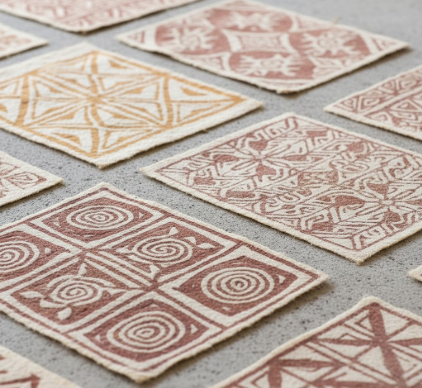
I used to think bark cloth was just, you know, some rustic craft thing—until I saw authentic Hawaiian kapa up close at a museum in Honolulu, patterns so intricate they looked almost digital.
The Beating Heart of Pattern Creation: How Ancient Hawaiians Made Kapa from Wauke Trees
Here’s the thing about kapa—it wasn’t just fabric, it was identity. Hawaiian artisans, mostly women, would strip bark from the wauke tree (paper mulberry, if you want the botanical name), soak it, then beat it with these grooved wooden mallets called i’e kuku for hours, sometimes days. The fibers would spread and merge, creating sheets that could be as thin as silk or thick as canvas, depending on what you needed. You could make clothing, blankets, ceremonial wrappings—basically everything textiles do now, except this was happening roughly a thousand years ago, give or take, with zero imported materials. The beating itself created the first layer of texture, these faint linear patterns from the mallet grooves that would show through even the most elaborate designs later. It’s exhausting just thinking about the repetitive labor, honestly, but that rhythmic pounding was also meditative, communal—women would work together, talking, teaching younger girls the exact angle to hold the beater. The knowledge transfer wasn’t written down anywhere; it lived in muscle memory, in the slight calluses on palms, in knowing exactly when the bark had been beaten enough but not too much.
Geometric Precision Meets Spiritual Symbolism in Traditional Kapa Patterns
Wait—maybe I’m getting ahead of myself. The patterns themselves were applied after the beating, using bamboo stamps (‘ohe kapala) carved with geometric designs or freehand painting with natural dyes. Triangles, diamonds, chevrons—these weren’t random decorative choices. Certain patterns indicated rank, family lineage, even geographic origin within the islands. A zigzag motif might reference shark teeth (niho mano), invoking protection and strength, while parallel lines could represent rain, fertility, the genealogical connections between chiefs and gods. The colors came from local sources: black from burnt kukui nut soot, red-brown from red clay, yellow from turmeric root, sometimes mixed with plant juices to create variations. I guess it makes sense that a culture so connected to place would literally wear the land—earth, plants, volcanic minerals—on their bodies.
Colonial Disruption and the Near-Death of Kapa Making Traditions
Then missionaries arrived in the 1820s, bringing cotton fabric and, more damagingly, shame about indigenous practices.
Kapa production collapsed within a generation—turns out cultural genocide is pretty efficient when you convince people their ancestral knowledge is primitive. By the early 1900s, almost nobody was making kapa anymore; the techniques survived mostly in museum collections and fragmented oral histories. A few elders remembered watching their grandmothers work, but the continuous chain of daily practice had been severed. It’s one of those historical losses that feels both massive and invisible—like, we can document what disappeared, but we can’t fully know what the living tradition felt like, the variations and innovations that would’ve evolved over the past century if colonization hadn’t interrupted everything.
Contemporary Revival and How Modern Artists Are Reclaiming Kapa Design Languages
Honestly, the revival movement that started in the 1970s still amazes me. Artists like Dalani Tanahy and Puanani Van Dorpe began laboriously reconstructing the process from museum specimens, old photographs, whatever they could find—teaching themselves to beat bark, rediscovering dye formulas through trial and error. Younger artists now are pushing it further, combining traditional geometric vocabularies with contemporary themes, creating kapa that references climate change, native sovereignty, diaspora. Some use the patterns in digital design, fashion, even tattoo art (though that gets complicated—some argue certain sacred patterns shouldn’t be commercialized). The designs have definately entered global visual culture; you’ll see kapa-inspired prints on surfboards, hotel decor, which raises questions about appropriation versus appreciation. I’ve seen non-Hawaiian designers use those triangle motifs without understanding they might be referencing specific ali’i lineages, which feels uncomfortable, but I’ve also met Hawaiian artists who want the patterns to circulate widely, to remind people that Polynesian design sophistication predates Western contact by centuries.
Why Kapa Patterns Still Matter in Conversations About Indigenous Design Sovereignty
There’s this broader conversation happening now about who owns cultural patterns—can geometric designs be copyrighted, should they be? Kapa raises all these questions because the patterns weren’t just aesthetic; they were genealogical records, spiritual protection, political statements woven into cloth. When you see that chevron pattern on a throw pillow at Target, divorced from context, something’s lost. But maybe something’s also preserved—the sheer visual power of those designs, their ability to catch your eye across centuries and mediums. I don’t have a tidy answer here. What I do know is that every time a Hawaiian artist beats wauke bark today, mixing earth pigments, stamping those ancient geometries onto new cloth, they’re doing something that’s simultaneously preservation and reinvention, reclaiming a design language that colonization tried to erase but couldn’t quite kill.


