
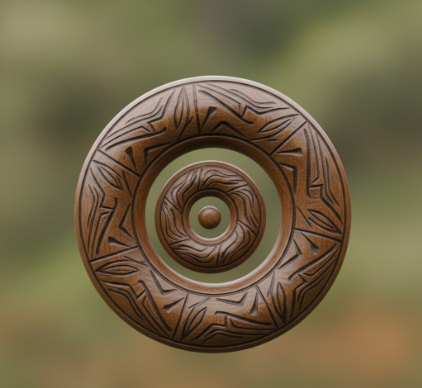
I used to think spirals were just… spirals.
Then I spent three weeks in Aotearoa New Zealand, and everywhere I looked—airport signage, corporate logos, tattoos on forearms at the fish market—there was this particular curl, tight at the center, unfurling outward like something alive. The koru, they called it, derived from the Māori word for “loop” or “coil,” but really it’s the shape of a new fern frond before it opens. The silver fern, specifically, pikopiko in te reo Māori, which grows everywhere in those wet forests. And here’s the thing: this wasn’t just decorative. Every person I asked had a different take on what it meant—new beginnings, yeah, but also perpetual movement, growth, harmony, the way time doesn’t really move forward so much as it spirals back on itself, carrying the past into the future. One woman at a design studio in Wellington told me her grandmother saw the universe in it, which honestly didn’t seem like much of an exaggeration when you’re standing in a meeting room plastered with koru-patterned wallpaper, drinking coffee from a koru-stamped mug.
The spiral shows up in Māori culture long before European contact, carved into whakairo (traditional wood carvings), etched into pounamu (greenstone), woven into tukutuku panels.
It’s not static symbolism, though—wait, maybe that’s the wrong way to say it. What I mean is, the koru doesn’t represent growth the way a stock photo of a seedling represents growth. It enacts it. The form itself performs the meaning: that tightly coiled center (the kōrari, sometimes called the core or origin point) holds potential energy, and as your eye traces outward, you’re participating in the unfurling, the becoming. Rangi Kipa, a Māori artist I didn’t get to interview but whose work I definitely stalked online, talks about how the koru connects whakapapa (genealogy) to the land itself—your ancestors aren’t metaphorically like ferns, they’re literally of the same substance, the same patterns of emergence and decay and re-emergence. Turns out Indigenous cosmologies don’t always separate human from non-human the way Cartesian thought does, which probably seems obvious but still manages to feel revelatory when you’re staring at a 200-year-old carving.
The Uncomfortable Reality of Appropriation and Commercial Koru Use
And then there’s Air New Zealand.
Their logo is a koru—has been since 1973—and depending on who you ask, this is either a beautiful example of national identity made visible or a textbook case of cultural appropriation by a corporation with, let’s say, a complicated relationship to Māori sovereignty. I guess it makes sense that a symbol this potent would get absorbed into branding; capitalism does that, finds things that resonate and turns them into fonts. But I kept thinking about the designer who originally pitched it, probably in some beige boardroom, and whether anyone asked permission, or whether “national symbol” was assumed to mean “publicly available.” The Māori Language Commission and various iwi (tribes) have pushed back against misuse for decades—there are guidelines now, frameworks for respectful incorporation, but enforcement is… let’s just say uneven. You can buy koru earrings on Etsy made by someone in Ohio who’s never heard of the Treaty of Waitangi, which maybe doesn’t matter in the grand cosmological scheme but definitely matters if you’re Māori and your sacred geometry is being sold next to “boho chic” dreamcatchers.
How the Spiral Connects Temporal Cycles to Spatial Growth Patterns
There’s a mathematical elegance to the koru that I didn’t appreciate until a physicist friend pointed it out.
Spirals—specifically logarithmic spirals, the kind you see in nautilus shells and galaxies—maintain the same shape at every scale. Zoom in, zoom out, the proportions hold. The koru isn’t precisely logarithmic (it’s more stylized, artistic license and all that), but it gestures toward the same principle: self-similarity, recursion, the idea that patterns repeat across different orders of magnitude. In Māori thought, this isn’t just aesthetic coincidence. The koru embodies whakataukī (proverbs) like “ka hinga atu he tētēkura, ka hara mai he tētēkura”—loosely, as one frond dies, another unfurls. Cycles within cycles. Your great-great-grandmother’s life coiling into yours, which coils into your grandchildren’s, none of it linear, all of it connected by this geometric logic that shows up in biological growth, in storm systems, in the way rivers meander. I used to think symbols were arbitrary—like, we just agree that a dove means peace—but the koru suggests maybe some symbols are discovered, not invented, because they’re already there in the structure of things.
Why Western Designers Keep Getting the Koru Wrong (And What That Reveals)
Honestly, you can always tell when a non-Māori designer has used a koru.
It’s too perfect, too symmetrical, polished to the point of sterility. The traditional koru has irregularities—the line thickness varies, the curve tightens or loosens, there’s a hand-drawn quality even when it’s carved in stone. That’s not lack of skill; it’s presence of life. Western design education trains you to clean things up, eliminate wobble, achieve Platonic perfection. But the koru isn’t Platonic. It’s specific, contextual, embedded in a particular ecology where ferns grow in particular ways, where humidity affects unfurling speed, where no two fronds are identical. When you strip that specificity away to make it “scalable” or “brand-friendly,” you’re left with something that looks like a koru but doesn’t breathe like one. A few years ago, there was this whole controversy when a Auckland architecture firm used koru patterns in a building facade but rendered them in stark white against black—high contrast, very modernist—and Māori critics pointed out that te ao Māori (the Māori world) doesn’t really do that kind of binary opposition. The natural koru exists in gradients, in the greenish-brown of new growth, the dappled light of forest floors. Anyway, the building’s still there, and it still looks wrong to me, though I can’t always articulate why.
The Koru as Living Metaphor in Contemporary Indigenous Futurism
Maybe the most interesting thing happening now is how young Māori artists are remixing the koru for the digital age.
I’m thinking of people like Kura Puke, who does these augmented reality installations where virtual koru unfurl in real-time over urban landscapes, or Paratene Ngata’s generative art projects that use algorithms to create infinite koru variations, each one unique but recognizably of the same whānau (family). There’s something defiant about it—taking a symbol that’s been flattened into logo-dom and reanimating it, making it weird and unpredictable again. In Indigenous futurism (which, if you haven’t encountered it, is basically speculative fiction and art that centers Indigenous perspectives and futures), the koru becomes a way to imagine time non-linearly, to resist the colonial narrative of “progress” as a straight line from primitive to modern. If time spirals, then the future can contain the past, traditional knowledge can inform technological innovation, and you don’t have to choose between being authentically Māori and being a 21st-century digital native. The koru says: you can be both, you can be more, you can keep unfurling without erasing where you came from. Which maybe sounds like inspirational poster nonsense, but when it’s embedded in actual artistic practice—in code, in VR, in kinetic sculpture—it starts to feel less like metaphor and more like method.


