
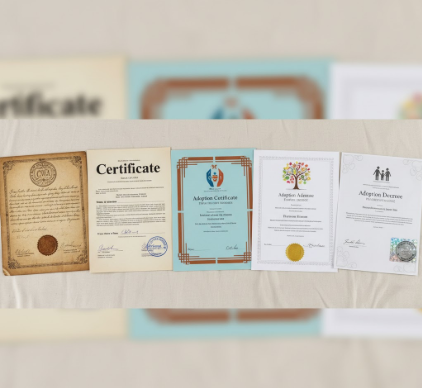
I used to think adoption certificates were just bureaucratic afterthoughts—bland documents stamped out by whatever printing press happened to be closest to the courthouse.
Turns out, the design evolution of these certificates tracks almost perfectly with shifting cultural attitudes about adoption itself, which is sort of fascinating when you dig into it. The earliest formal adoption certificates in the United States, dating back to the 1850s after Massachusetts passed the first modern adoption law in 1851, were deliberately austere—black ink on cream paper, heavy serif fonts that screamed “legal document.” They looked indistinguishable from property deeds, which, honestly, makes a certain grim sense given that adoption laws emerged partly from indenture practices. The language was transactional: “transferred,” “conveyed,” “relinquished.” These certificates weren’t celebrating families; they were documenting ownership changes, and the design reflected that uncomfortable reality.
By the 1920s, things started shifting. Progressive Era reformers pushed adoption as a humanitarian rescue operation, and certificates began incorporating softer visual elements—decorative borders, occasionally a small embossed seal. Still formal, but less overtly legalistic.
The mid-century Baby Scoop Era brought another transformation, though not necessarily a positive one. Between roughly 1945 and 1973, when an estimated 1.5 to 4 million adoptions occured (the data’s messy, historians argue about the numbers), certificates became paradoxically more ornate while simultaneously erasing more information. States sealed original birth certificates and issued amended ones with adoptive parents listed as biological parents—a bureaucratic fiction that certificates reinforced through their design. They started looking more like commemorative documents, with elaborate calligraphy and floral motifs, as if the decorative excess could paper over the genetic disconnection. Wait—maybe that’s too cynical, but I’ve seen examples from this period that feel almost aggressively cheerful in their denial of adoption’s complexities.
How Social Movements Literally Redesigned the Paper Trail
The adoptee rights movement of the 1970s didn’t immediately change certificate design, but it planted seeds.
Activists argued that sealed records and falsified birth certificates caused psychological harm, and slowly—painfully slowly—some jurisdictions began offering “open adoption” options where birth parent information remained accessible. The certificates themselves started carrying dual identities: legal documents that acknowledged adoption openly rather than disguising it. Oregon, which restored adoptee access to original birth certificates in 2000, began issuing certificates with clearer language: “Certificate of Adoption” rather than amended birth certificates that pretended adoptive parents had given birth. The design language shifted from concealment to transparency, though plenty of states still haven’t caught up. Contemporary certificates sometimes include space for birth parent names alongside adoptive parents, use gender-neutral language (“parent” instead of “mother/father”), and employ cleaner, more modern typography that conveys official legitimacy without the Victorian fussiness.
The Digital Age Hasn’t Solved the Fundamental Design Problem
Here’s the thing: even as certificates moved online and states developed digital issuance systems, the core tension remains unresolved.
Should an adoption certificate primarily serve the adoptive family’s desire for normalcy, or should it honor the adopted person’s right to their full history? Different states answer differently, and you can literally see it in the documents. Some jurisdictions now offer customizable certificates where families can choose decorative elements—borders, fonts, even subtle watermarks—treating them almost like wedding announcements. Others maintain stark, utilitarian designs that emphasize the legal function over the commemorative one. There’s no consensus, which maybe reflects our broader cultural ambivalence about adoption itself. I guess what strikes me most is how much weight we’ve placed on these pieces of paper—asking them to simultaneously legitimize families, protect privacy, preserve history, and celebrate new beginnings. That’s a lot to ask from a document design, and honestly, I’m not sure we’ve figured it out yet.
The evolution continues, messy and unfinished.


